
PS6 Design: What PlayStation History Tells Us and How to Spot a Fake Render
Author: Martin Pavlič / / Updated:
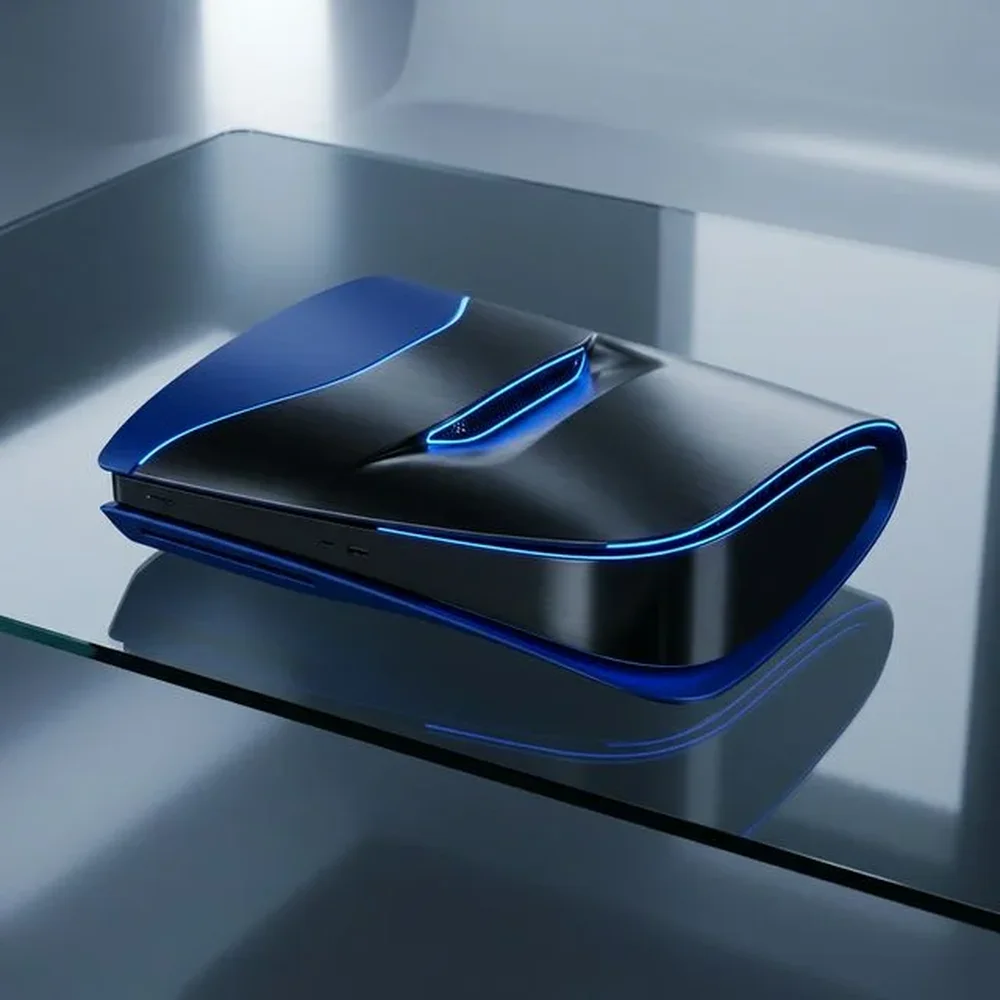
Sony has not shown what the PS6 looks like, and every PS6 “design” circulating online is a fan render, an AI image or a guess. What does exist is thirty years of documented PlayStation hardware, which says a lot about what a launch console usually looks like and what changes later.
An earlier version of this article described a 3nm chassis, a 160W chip budget and a modular drive tied to a fixed digital price as if they were known. None of that was sourced, and it has been removed.
What Sony’s own hardware record shows
Every PlayStation generation has followed the same pattern: a large launch model, then a smaller revision a few years later.
| Model | Launched | What Sony said changed |
|---|---|---|
| PS one | July 2000 (Japan) | Smaller redesign of the 1994 PlayStation (timeline) |
| PS2 redesign | November 2004 | Slimmer PS2 four years after launch (timeline) |
| PS3 slim | September 2009 | ”Slimmer form factor” 120 GB model (PlayStation Blog) |
| PS3, 2012 model | 2012 | About 25% smaller and 20% lighter than the previous PS3 (PlayStation Blog) |
| PS4 slim | September 2016 | Volume down 30%, weight down 16%, power consumption down 28% (PlayStation Blog) |
| PS5 (launch) | November 2020 | About 390 x 104 x 260 mm and 4.5 kg; Digital Edition 390 x 92 x 260 mm and 3.9 kg (PS5 FAQ) |
| PS5, 2023 model | November 2023 | About 358 x 96 x 216 mm and 3.2 kg; over 30% less volume; attachable disc drive (PlayStation Blog) |
| PS5 Pro | November 2024 | About 388 x 89 x 216 mm and 3.1 kg (Sony safety guide); no built-in drive (PlayStation Blog) |
Two things stand out. First, the slim revision arrives three to six years after launch, so the console you can buy on day one is never the smallest version of that generation. Second, the PS5 Pro breaks the “more power, bigger box” assumption. Sony said its height matches the original PS5 and its width matches the slimmer current model (PlayStation Blog). Multiplying the published outer dimensions gives a bounding box of about 7.5 litres for the Pro, against about 10.5 litres for the launch PS5 and 7.4 litres for the 2023 model. That is our arithmetic, not a Sony figure, and it ignores the curved shell, but it shows Sony fitted its most powerful console into roughly the slim model’s footprint.
The early-generation story is covered in more depth in our PlayStation 1 history and PS5 Pro guides.
The trade-offs any PS6 chassis has to solve
A console shell is a compromise between heat, noise, cost and shelf space. Sony’s teardowns show how it handled each on PS5 hardware.
- Cooling versus size. In the PS5 Pro teardown, Sony explained that the Pro needs more air, uses a larger fan and more heat pipes, and has a power supply that outputs about 48W more than the standard PS5.
- Noise. The same teardown describes a louvre that directs fan noise away from the front, where players sit. For the launch PS5, Sony hardware engineering EVP Masayasu Ito wrote that the team balanced “reducing the noise level” against “enhancing the cooling capacity”. Whether a PS6 is quieter than a PS5 depends on its power draw, which Sony has not disclosed.
- Disc drive. Taking the drive out of the box lowers the base price and lets one chassis serve both kinds of buyer. Sony sold the 2023 model’s attachable drive separately for $79.99 (PlayStation Blog), and the PS5 Pro shipped “disc-less” with that drive as an option (PlayStation Blog). The cost moves to the buyer who wants discs.
- Customisation and accessories. The 2023 model has four separate cover panels, and its vertical stand is sold separately (PlayStation Blog).
Ask the same of any PS6 design claim: how is it cooled, how loud is it, where is the drive, and what is sold separately. Those answers matter more for your desk and budget than the shell’s shape, and the PS6 price guide explains why an included or optional drive changes the comparison.
What the January 2028 disc decision might mean for the shape
On 1 July 2026 Sony announced on the PlayStation Blog that physical disc production for all new games on PlayStation consoles ends in January 2028. Games already released on disc, or releasing on disc before then, are not affected. The statement does not mention any console or disc drive.
Analysts read it as a hardware signal anyway. Piers Harding-Rolls of Ampere Analysis said the PS6 will “at a minimum” not include a disc drive and called dropping it “an easy win” for cost, while suggesting an add-on drive for older PS4 and PS5 discs is possible (PSU, 1 July 2026). That is an analyst opinion, not a Sony plan.
If he is right, the base console would not need room for an optical drive, and the drive would become an accessory, as on the PS5 Pro. Our PS6 disc drive guide covers the scenarios, and disc vs digital covers the buying decision.
How to spot a fake PS6 render
Hardware designs appear late. Sony showed the launch PS5 on 11 June 2020, about five months before its November release. It announced the 2023 PS5 model on 10 October 2023 (PlayStation Blog), a month before it launched, and revealed the PS5 Pro on 10 September 2024 ahead of a 7 November launch. Use this checklist on any image claiming to be the PS6.
| Check | What it tells you |
|---|---|
| Is the source the PlayStation Blog, a Sony event or Sony IR? | If not, it is not official, however polished it looks |
| Is it a patent drawing? | A real filing, but a weak predictor of a retail product (see below) |
| Does it come from a 3D artist, concept channel or AI tool? | A design opinion with no evidential value |
| Does it show ports, vents, labels and a power input? | Renders often skip the boring parts a real product must have |
| Can you find an earlier copy with reverse image search? | Many “leaks” are recycled concept art |
| Does a known leaker vouch for it, and has a second source confirmed it? | One unverified source is a rumour, not a leak |
The patent row deserves a precedent. In 2019 a Sony design patent showing a heavily vented box with a V-shaped cut-out was widely presented as the PS5. It was a real filing, which coverage linked to the development kit rather than the retail console, and KitGuru noted at the time that such illustrations “don’t always materialise into real physical products” (KitGuru). The retail PS5 looked nothing like it. We have found no Sony design filing credibly linked to a PS6 console.
See our graded PS6 leaks tracker, and for timing, the PS6 reveal guide and release date hub.
What to plan for today
Plan for a console at least as large as the PS5 Pro until Sony publishes dimensions, because launch models have historically been the largest of their generation. If you want discs, assume you may need to buy a drive separately. Compare generations in PS6 vs PS5, and see the specs page for leak-based estimates. A portable PS6 is a separate rumour, covered in PS6 handheld.
Frequently Asked Questions
What will the PS6 look like?
Nobody outside Sony knows. Sony has published no image, dimensions or design statement.
Will the PS6 be smaller than the PS5?
Unconfirmed. History suggests the launch PS6 will be larger than any later slim revision, and the PS5 Pro shows Sony can fit more power into a box about the size of the 2023 PS5.
Will the PS6 have a detachable disc drive?
Sony has not said. The 2023 PS5 and the PS5 Pro use a separately sold drive, and an Ampere analyst expects the PS6 to drop the built-in drive, but that is an analyst opinion.
When will Sony reveal the PS6 design?
Unknown. Recent PlayStation hardware was shown between one and five months before launch, so a “final design” appearing years ahead of a release deserves suspicion.
Are PS6 patent drawings reliable?
Patents are real filings but weak predictors. The 2019 PS5 design patent that circulated as the console did not match the retail PS5.
How can I tell if a PS6 render is fake?
Check whether it comes from Sony. A concept artist, AI tool or single unverified account is not evidence of the real design.