
PlayStation 1 History: From the Nintendo Split to 102 Million Consoles
Author: Martin Pavlič / / Updated:
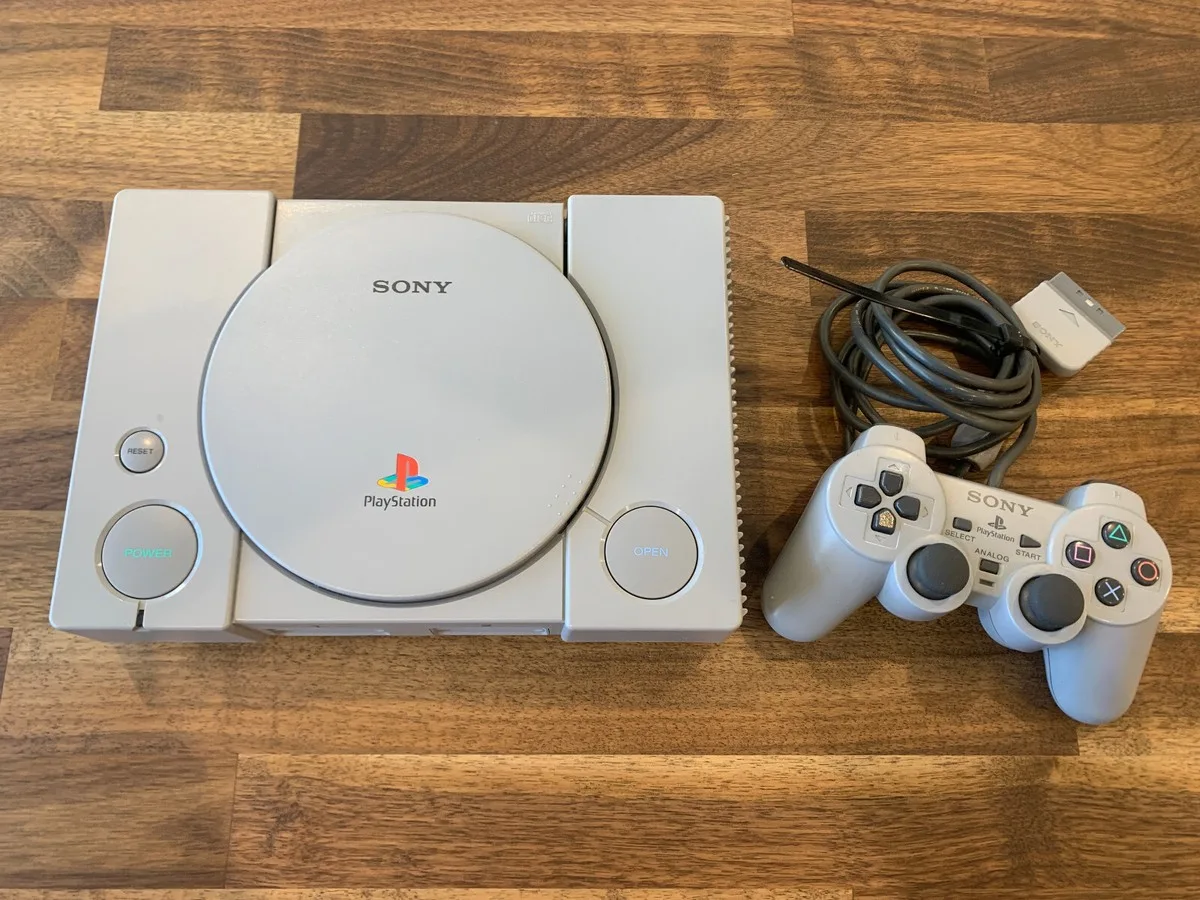
The original PlayStation launched in Japan on December 3, 1994, reached North America on September 9, 1995 and Europe on September 29, 1995, and went on to ship more than 102.4 million consoles. The dates come from Sony’s own 100-million press release, and the lifetime figure from Sony Interactive’s business data page, which counts sell-in shipments as of March 31, 2012.
It was the first game console to pass 100 million units. The way it got there (a failed partnership, a cheap disc format, an aggressive price and a machine that was easy to program) still explains a lot about how Sony approaches a new generation, including the one that will lead to PS6.
PS1 at a glance
| Fact | Detail | Source |
|---|---|---|
| Japan launch | December 3, 1994, list price ¥39,800 | Sony, ASCII |
| North America launch | September 9, 1995, $299 | Sony, heise |
| Europe/PAL launch | September 29, 1995 | Sony |
| PS one redesign | Japan July 7, 2000; US September 19, 2000 at $99 | Famitsu, Sony |
| Lifetime hardware | More than 102.4 million (as of March 31, 2012) | Sony Interactive |
| Lifetime software | More than 962.0 million units | Sony Interactive |
How a Nintendo deal turned into PlayStation
PlayStation began as a CD-ROM reader for the Super Nintendo, a cartridge-only console. Sony and Nintendo were developing it together until 1991, when, hours after Sony unveiled its project in Las Vegas, Nintendo partnered with Philips instead. Ken Kutaragi, the engineer who drove the project, told AFP in a 2024 interview published by Fortune that without that snub the PlayStation “would never have seen the light of day”.
The same interview makes a less famous point: most Sony executives opposed the project, worried that a games machine would damage the company’s reputation for high-end electronics. The PlayStation was not a safe corporate bet. It was an engineer’s argument that won.
Accounts of why the joint project collapsed (control of the software, revenue terms) differ between participants. Our earlier version stated one motive as fact; we now stick to what is documented: the partnership ended and Sony built its own console.
Why the CD-ROM mattered more than the chip
Sony’s PlayStation history page puts it plainly: CD-ROM let games be much bigger than cartridge alternatives, and Sony credits the format with classics like Final Fantasy VII. Cost mattered as much as capacity. Japanese outlet ASCII notes that cheap disc manufacturing helped pull down software prices that had climbed close to ¥10,000 per game in the cartridge era.
The hardware was built around the disc. According to Rodrigo Copetti’s architecture analysis, a dedicated decoder (MDEC) could play full-motion video at 320x240 and 30 fps, and the CD controller streamed compressed audio straight into sound memory without loading the main processor. That is why so many PS1 games are remembered for their cinematics and CD-quality soundtracks.
The trade-offs were real. A double-speed drive feeding 2 MB of RAM meant loading screens, and Copetti documents that units made up to 1997 had a laser fault that could make video and audio skip. Discs were also easier to copy than cartridges, which Sony answered with a physical disc check that modchips later imitated.
| PS1 hardware | Specification |
|---|---|
| CPU | 32-bit, 33.8688 MHz (MIPS R3000 family) |
| Main memory | 16 Mbit (2 MB) |
| Graphics memory | 8 Mbit (1 MB) |
| Sound memory | 4 Mbit (512 KB) |
| Drive | 2x CD-ROM, also plays audio CDs |
| 3D | Up to 360,000 polygons per second |
Clock, memory and drive figures are from Sony’s PS one press release, which describes the same hardware as the original; the polygon figure is from Sony’s history page.
The $299 moment and the price war
At E3 on May 11, 1995, Sega announced the Saturn at $399. A few hours later Sony’s Steve Race walked on stage, said “299” and walked off, as heise recounts. The same article notes that the US price fell to $199 about a year after launch.
In today’s money, $299 in September 1995 is roughly $660, based on the US CPI-U index from the Bureau of Labor Statistics (153.2 in September 1995, 336.9 in September 2026). An earlier version of this article said about $600, which understated it.
The games that built the library
Sony’s history page highlights the titles that defined each year: Ridge Racer and Tekken (1994), wipEout (1995), Tomb Raider, PaRappa the Rapper, Resident Evil and Crash Bandicoot (1996), Final Fantasy VII, Gran Turismo and Oddworld: Abe’s Oddysee (1997) and Metal Gear Solid (1998). Famitsu singles out Ridge Racer as the standout among the Japanese launch titles.
Volume followed. By the end of March 2004 the library counted more than 7,300 titles, per Sony’s press release. Developers worked with an SDK that included a C compiler and libraries, and Sony even sold the Net Yaroze hobbyist kit (Copetti), a clear signal that it wanted as many people as possible making games for the platform.
The controller also evolved mid-life: the Dual Analog arrived in April 1997, the DualShock with vibration in November 1997, and Ape Escape (1999) became the first game to require it, according to Sony’s history page.
PS one and the long tail
In 2000, the year PS2 arrived, Sony released the PS one: the same hardware in a case about one-third the size, weighing 550 g, at $99 in the US (Sony press release). It kept selling long after its successor launched: Sony reported more than 3.31 million PS one units shipped in fiscal 2003 alone.
By May 2004 cumulative shipments were 39.67 million in North America, 39.61 million in Europe/PAL and 20.72 million in Japan including Asia, per the 100-million release. A console launched in Japan ended up shipping roughly four in five units to North America and Europe.
What PS1 suggests about PS6 (analysis)
This section is our analysis, not Sony guidance. Sony has not announced PS6 hardware, a price or a date; see our release-date guide for the evidence status.
- Price is a launch weapon, but the scale has changed. PS1 undercut its rival by $100. Our current PS6 estimates are $799 to $999 (Gen6Specs estimates, not Sony prices), well above PS1’s roughly $660 in today’s money. Why PS6 will be expensive and our PS6 price guide explain the cost drivers.
- Media format shapes the business. PS1 won partly because discs were cheap. Today the direction runs the other way: Sony announced on the PlayStation Blog that disc production for new games ends in January 2028. Our disc drive guide covers what that does and does not mean for hardware.
- Ease of development builds libraries. PS1’s accessible tools helped it reach thousands of titles. A smooth path from PS5 development is the modern equivalent to watch for in any PS6 reveal.
- Mid-life redesigns extend a generation. PS one shipped millions after PS2 launched, which is one reason to weigh PS6 vs PS5 on your own library rather than assume the older console stops mattering on day one.
The hardware gap is enormous. PS1 had 2 MB of main memory; our working estimate for PS6 is 30 GB, an unconfirmed figure (see specs and performance). Our previous version called that a “million-fold” leap; the correct order of magnitude is roughly ten thousand times.
Frequently Asked Questions
When did the PlayStation 1 launch?
December 3, 1994 in Japan, September 9, 1995 in North America and September 29, 1995 in Europe, according to Sony.
How many PlayStation 1 consoles were sold?
More than 102.4 million, counting the original PlayStation and PS one, according to Sony Interactive’s sell-in data as of March 31, 2012. It was the first console to pass 100 million.
How much did the PS1 cost at launch?
¥39,800 in Japan and $299 in the United States. Based on US CPI data, $299 in 1995 is roughly $660 in 2026 money.
Why did Sony and Nintendo split?
Nintendo dropped the joint Super Nintendo CD-ROM project in 1991 and partnered with Philips instead. Sony then turned the work into its own console, driven by Ken Kutaragi.
Can you play PS1 games on PS6?
Not confirmed. On PS4 and PS5, a selection of original PlayStation games is available through the PlayStation Plus Premium classics catalog, as the PlayStation Blog announced in 2022. See backwards compatibility for what PS6 may support.
What was the PS one?
A smaller 2000 redesign of the original PlayStation with the same hardware, about one-third the size, sold for $99 in the US.